
Game guide · Snooker
Snooker: build a break one red and one colour at a time.
While reds remain, play a red followed by a chosen colour. After the final red, the colours leave the table in their fixed order.
- 3.569 × 1.778 m
- Official playing surface
- 52.5 mm
- Snooker-ball diameter
- 15 reds + 6 colours
- Object balls
- 1 through 7
- Ball values
The table and 22 balls
A full snooker set uses one white cue ball, fifteen reds and six colours: yellow, green, brown, blue, pink and black. The official playing surface measures 3.569 × 1.778 metres and each ball has a 52.5 millimetre diameter.
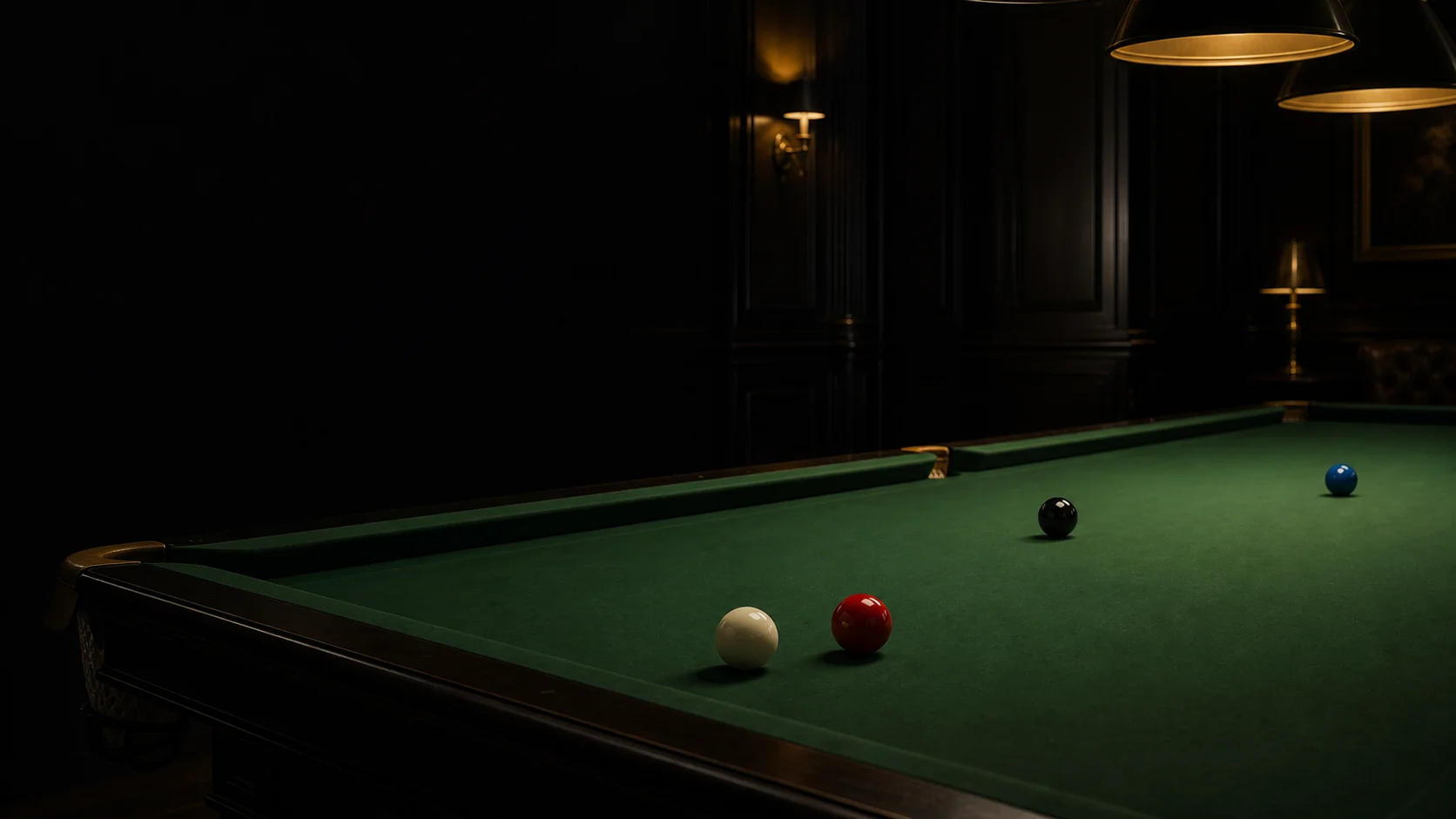
The reds start in a triangle and each colour has its own spot. Carambole places the full layout automatically. The hero image intentionally shows only four loose balls and is not a starting-layout diagram.
| Ball | Value | Fixed spot |
|---|---|---|
| Red | 1 | Triangle below pink |
| Yellow / green / brown | 2 / 3 / 4 | On or beside the baulk line |
| Blue | 5 | Centre of the table |
| Pink | 6 | Between blue and top cushion |
| Black | 7 | Near the top cushion |
Red, colour, red, colour
At the start of a turn, red is the ball on. Pocket one or more reds legally to score one point each and nominate a colour. A legally pocketed colour scores its value and is respotted while reds remain. Red then becomes the ball on again.
After the final red, one colour may still be played and respotted. The colours are then pocketed permanently in ascending order: yellow, green, brown, blue, pink and black.
Breaks, misses and safeties
A break is the number of points scored during one uninterrupted visit to the table. You continue after every legal score. When a pot is not responsible, play a safety: a legal stroke that leaves the opponent a difficult next ball.
A normal miss without a foul scores nothing and ends the turn. Strong snooker therefore balances break building against position and safety throughout the frame.
Fouls and penalty points
A foul ends the turn. Full tournament snooker also includes referee decisions such as foul and a miss, free ball, touching ball and exceptional spotting cases. Those require context beyond the scoring core.
- A legal ball on is not contacted first.
- The white cue ball enters a pocket.
- A ball that is not on is pocketed.
- No ball is contacted.
- The opponent receives at least four points; a higher involved colour can increase the penalty.
Winning the frame
After the final black, the higher score wins. A player may concede earlier when the deficit exceeds the points reasonably available, although fouls can theoretically add points.
If the scores are level after the final black, black is respotted and a sudden-death black decides the frame under the official procedure.
Official scoring core and Carambole
Carambole implements ball on, the red-colour sequence, nomination, values, respots while reds remain, the final colour sequence and fouls worth at least four points.
Referee cases including free ball and foul and a miss are not implemented. That limitation is stated in the game and here, so the guide does not claim a complete referee simulation while the playable scoring core remains clear.
Sources and verification
Content last verified on 8 August 2026. In official competition, the current governing rulebook takes precedence.
Put the theory on the table.
Choose the discipline in Carambole and practise the rules without a download.