Zero means the standard team car.
Setup values in the campaign are offsets. At zero, Vector still drives like Vector and Verdant still drives like Verdant. A setup does not erase the original vehicle definition; it adjusts that car around its own baseline.
A control only becomes available when the matching garage part is installed. Wings open aero trim, splitters open aero balance, uprights open wheel geometry and gearbox hardware opens ratio adjustment. Owning a part without fitting it is not enough.
Start by deciding which end of the car needs help. Only then add a small amount. Large changes can hide the original problem behind a new one.
Four wheels, three different geometry ideas.
Camber describes wheel tilt, toe describes where the tyres point from above, and caster belongs to the steering geometry at the front axle. The setup screen uses different car views so front and rear cannot be mistaken for one another.

Front camber
More negative front camber supports the loaded outside tyre in a corner and sharpens front grip. The cost is less straight-line contact for braking.
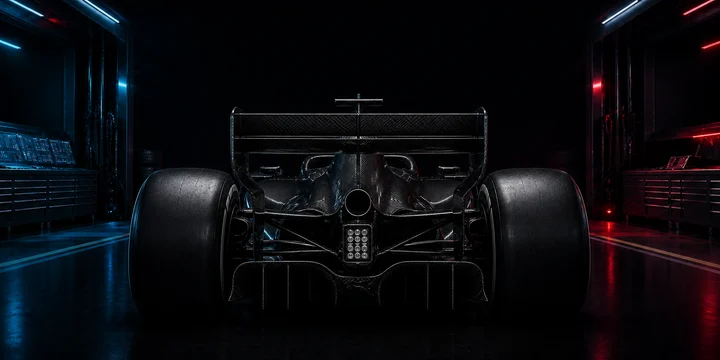
Rear camber
More negative rear camber stabilizes fast corners, while too much removes straight-line traction from the driven rear wheels.
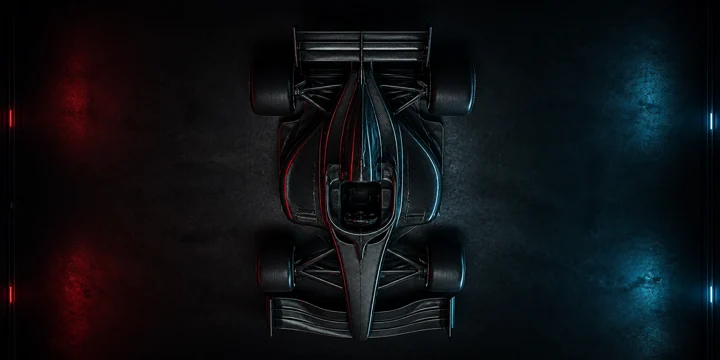
Front and rear toe
Negative is toe-out; positive is toe-in. Front toe-out sharpens turn-in. Rear toe-in calms slides. Rear toe-out frees rotation but raises spin risk.

Front caster
Caster is a front-axle setting. More caster improves self-centering and adds camber gain while steering; it is never illustrated at the rear wheels.
Decide whether the car needs load, balance or both.
Downforce trim has two choices. Standard keeps the rear wing lightly angled forward for lower drag. High downforce angles it farther forward, pressing the car into fast corners while reducing straight-line speed. The wing never points upward.
Aero balance then moves existing aerodynamic load between the axles: more front produces stronger turn-in but can make the rear nervous; more rear calms the car at the cost of nose response. Weight distribution similarly moves ballast forward or rearward, but it feeds mechanical load at all four tyres rather than only aerodynamic load.
Match the usable rev range to the route.
Final drive applies one gearing change to the whole gearbox. Positive means shorter: stronger pull and an earlier limiter. Negative means longer: more potential top end and less acceleration. Individual gear ratios then let you adjust the gears used in corners without moving the entire stack.
The automatic shift point tells the controller where to take the next gear, up to 12,500 rpm. Higher only helps while the power curve still carries. The rev limiter controls how far the engine can continue, but extra revs beyond the power peak do not create free acceleration.
Fuel mixture and ignition timing are read with the dyno. More fuel can correct a lean high-rpm build. More ignition advance can add torque until knock appears; knock then forces a power loss. These are connected adjustments, not independent bonus sliders.
Separate how hard the car reacts from where it reacts.
Anti-roll stiffness uses negative for stiffer and positive for softer. Stiffer keeps the car flatter on a smooth surface; softer is more forgiving over kerbs. Anti-roll balance uses negative for more front stiffness and positive for more rear stiffness. A rear-stiff direction sharpens rotation but can reduce exit traction.
Brake pressure controls how hard the system can stop before the tyres saturate. Brake bias controls where that effort goes. Positive moves bias forward for stability; negative moves it rearward for rotation and greater spin risk.
Change one cause, then read one result.
Begin with the standard car and name the problem in a repeatable corner: understeer on entry, nervous rear at speed, wheelspin on exit or limiter too early on the straight. Change one relevant setting by one or two steps, repeat the same section and compare.
When the setup improves that section without creating a larger loss elsewhere, keep it. If the car becomes inconsistent, return toward zero. The tuning screen stores a useful circuit setup; it does not reward moving every slider away from standard.
See how the setup enters the vehicle systems →