
Simulation supports the race instead of slowing it down.
Sky Division 2 is not presented as a full professional motorsport simulator. Steering and race access remain deliberately direct. The simulation layer exists to make understandable decisions matter: a wet track should feel different, a worn rear tyre should change traction and a high-downforce build should pay for its corner grip on the straight.
The garage, setup screen, dyno, telemetry and race physics use the same vehicle data. That is the important part: a number does not live only on a menu card. It follows the car onto the circuit.
The current model covers vehicle performance and race conditions. This page does not claim unimplemented systems such as crash damage or a professional engineering-grade tyre model.
Every corner of the car has its own state.
Front-left, front-right, rear-left and rear-right tyres each track temperature, pressure, remaining wear, suspension compression, normal load, available grip and wheelspin. Braking adds more heat to the front; driven-wheel spin adds heat and wear at the rear; cornering shifts load across the car.
Pressure rises with temperature. Grip is best around the intended operating window, while overheated or heavily worn tyres provide less useful performance. Because Sky Division 2 is rear-wheel drive, traction mistakes appear first as rear wheelspin rather than an abstract whole-car penalty.
Heat changes grip
Speed, slip, braking, wheelspin and load build heat; rain cools the target temperature.
Cold is not hot
Each corner begins at a cold pressure and rises with its own temperature state.
A stint has a cost
Slip, braking, wheelspin and overheated running consume the tyre over time.
Grip is distributed
Aero, mass and acceleration decide how much normal force each tyre carries.
Rear traction is visible
Excess drive demand becomes rear wheelspin, heat and additional wear.
The state is readable
The race HUD reports each tyre so the driver can connect behavior to a cause.
Rain changes the surface; clearing weather changes it again.
Weather is not a single visual toggle. A wetness value builds toward the rain target while precipitation is active, reducing grip and cooling the tyres. When the rain clears, that value falls over time and the usable surface returns rather than snapping instantly to dry.
Campaign forecasts are deterministic per round, so the same campaign event has a stable condition to plan around. Some races begin dry and turn wet; others begin wet and clear. Garage choices can also carry explicit wet-grip compromises, which makes the forecast relevant before the start.
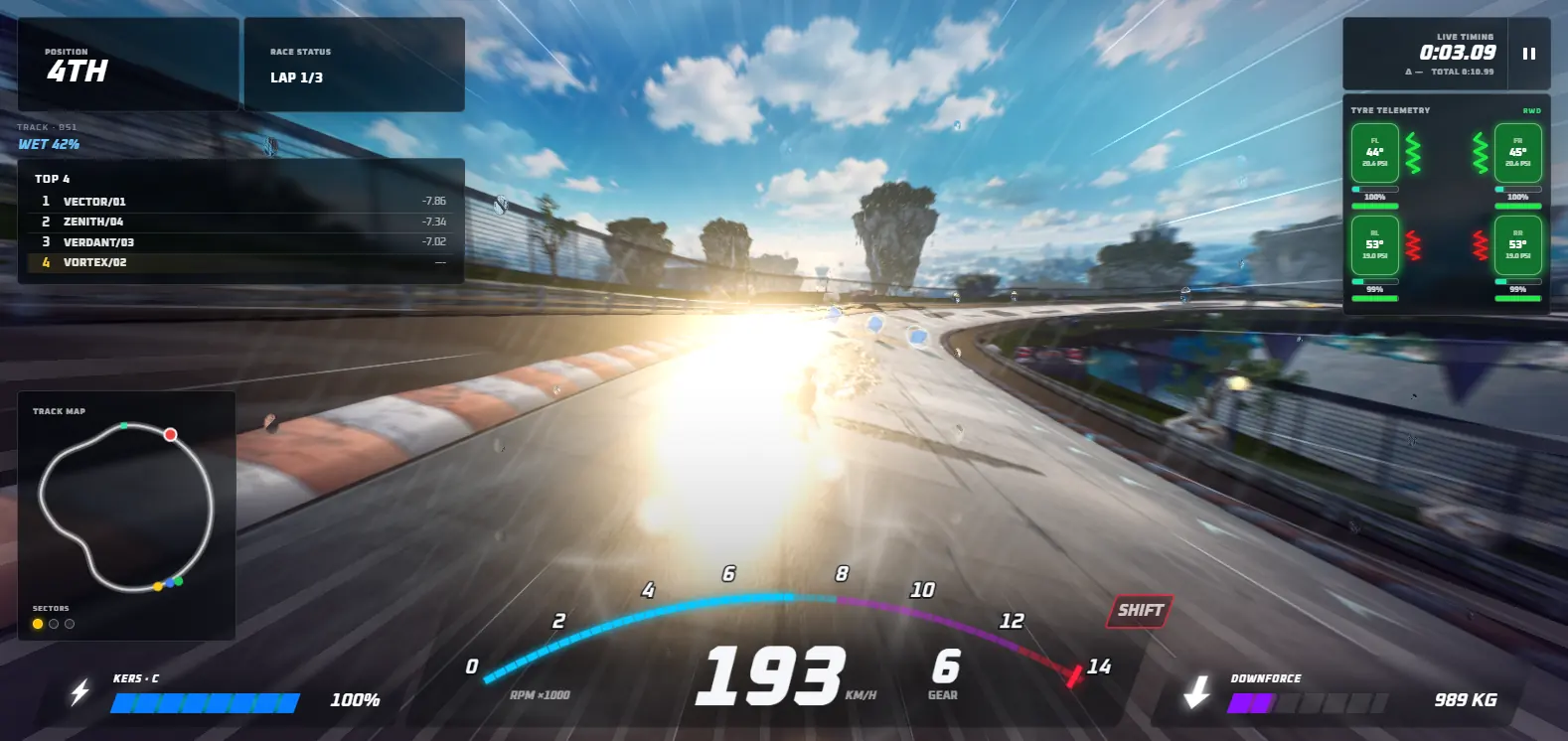
The four tyres carry a moving car, not a static stat sheet.
Acceleration moves load rearward, braking produces front load and brake dive, and cornering transfers load from the inside to the outside. Suspension tuning can change how sharply the body reacts, while weight distribution changes the baseline shared by all four tyres.
Aerodynamic downforce rises with speed and is split between the front and rear axles. Higher wing trim multiplies downforce but also drag. Rolling resistance also increases under aerodynamic load, so adding aero is intentionally not a free corner-speed button.
Camber, toe and caster then modify how each axle turns that load into usable grip. This is why front and rear setup directions matter differently even when the slider range looks symmetrical.
Power must pass through revs, gears and rear tyres.
Each team car has a torque peak, power peak, redline and final-drive definition. Bore and stroke change displacement and reshape output; valvetrain and cam choices move the power character; exhaust and ECU parts change how much of that potential reaches the curve.
Gear ratios convert engine torque into drive force at the tyre. Short gearing accelerates harder and reaches the limiter earlier. Long gearing creates more speed range but reduces force at the road. The automatic shift controller uses its configured shift point, while manual control lets the driver make that decision directly.
The base KERS system stores 400 kJ, can deploy 60 kW and recovers energy under braking. ERS upgrades can change battery capacity, deployment power and recovery efficiency. Deployment therefore has both a power limit and an energy budget.
The useful simulation is the connection.
A high-downforce car loads the tyres harder at speed, pays more drag, and may need different gearing. A softer tyre can improve corner grip but add wear and wet-weather risk. More rear brake bias may help rotation but heat and unsettle the rear axle. None of these systems needs to be professional-grade to create a meaningful choice; they need to agree with one another.
That connected behavior is also why race format matters. A single qualifying lap rewards a different margin than eight endurance laps in changing weather.
See how the systems matter across race formats →